Spain’s Animal Welfare Law 7/2023: What Pet Owners in Marbella Need to Know

By Dr. Rocío Cromstedt Lavigne, MRCVS
Veterinary Surgeon & Co-Founder of MYVET Marbella
When Alberto and I decided to create MYVET Marbella, we were not only thinking about opening a veterinary clinic.
We were thinking about the kind of relationship we want families to have with their pets.
A relationship based on love, responsibility, prevention, trust and respect.
Because for most of us, our dog or cat is not “just an animal”. They are part of the family. They wait for us at the door. They sleep next to us. They notice when we are sad. They make our house feel like home.
That is why Spain’s Ley 7/2023, de 28 de marzo, de protección de los derechos y el bienestar de los animales, commonly known as the Animal Welfare Law, is so important.
It is not just another legal text.
It is a reminder that having a pet is a privilege — and also a responsibility.
For many families living in Marbella, San Pedro de Alcántara, Nueva Andalucía, Estepona, Benahavís or elsewhere on the Costa del Sol, this law has created questions:
Do I need insurance for my dog?
Does my cat need to be sterilised?
Can I leave my dog alone at home?
Does my pet need a microchip?
What if I adopted my pet abroad?
What happens if my pet gets lost?
What does “responsible ownership” really mean?
In this article, I want to explain the law in a clear, practical and friendly way — not as a lawyer, but as a veterinarian who sees every day how much families love their animals and how important it is to protect them properly.
First, what is Spain’s Animal Welfare Law 7/2023?
Spain’s Animal Welfare Law 7/2023 is a national law created to protect the rights and welfare of animals, especially companion animals such as dogs, cats and ferrets.
The law recognises that animals are sentient beings. This means they can feel pain, fear, stress, comfort, safety and affection.
For pet owners, the law reinforces a very simple idea:
If an animal lives with us, we are responsible for their health, safety, identification, welfare and quality of life.
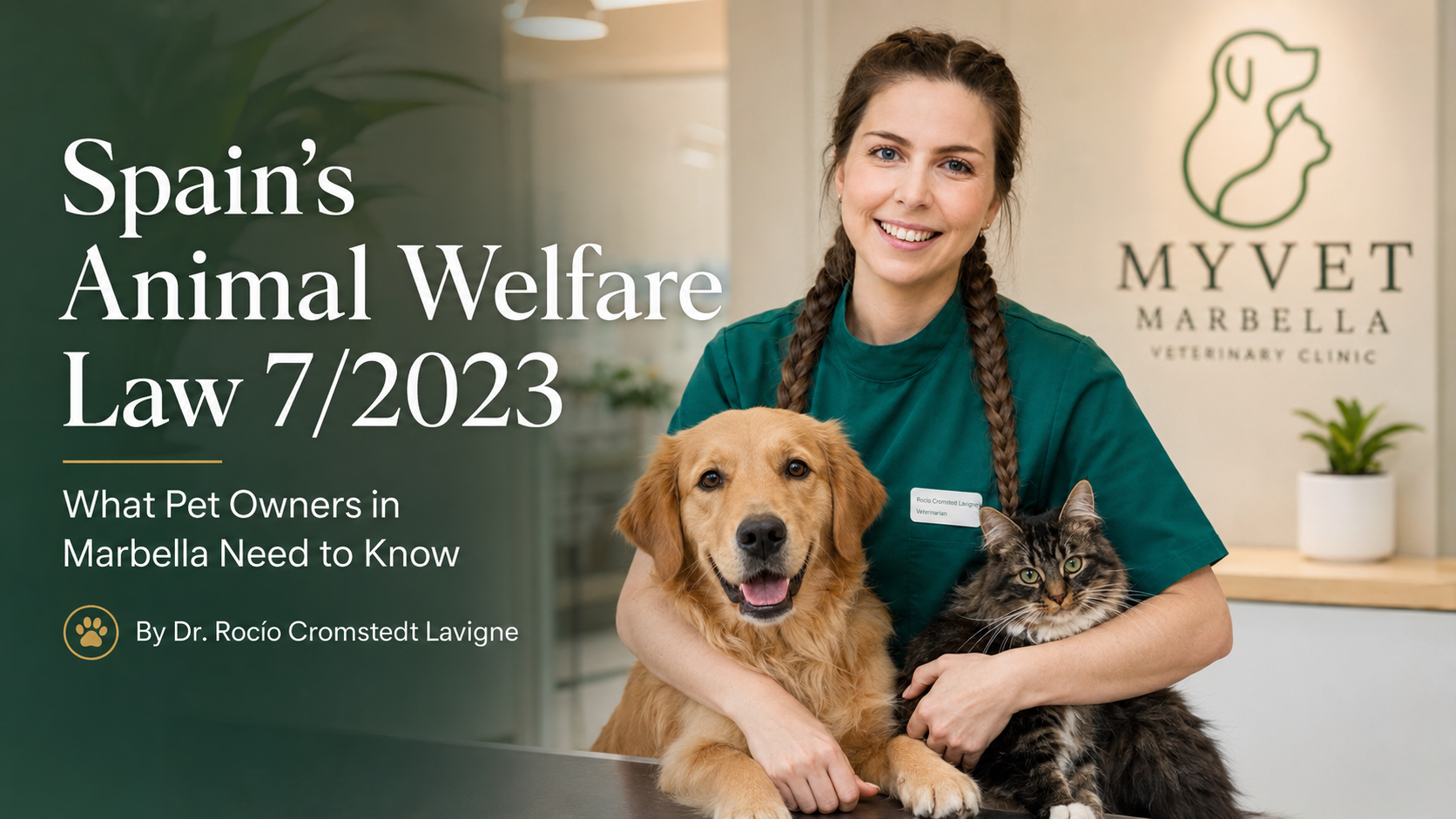
Spain’s Animal Welfare Law 7/2023 reinforces responsible pet ownership, identification, veterinary care and animal welfare for dogs and cats.
In practical terms, this affects everyday decisions: veterinary care, microchipping, sterilisation, leaving animals alone, breeding, adoption, sale, transport, behaviour, supervision and prevention of abandonment.
Why does this matter so much in Marbella?
Marbella is a very international area.
Many of our clients are Spanish families, British residents, Irish residents, Scandinavian families, Dutch owners, French owners, German owners and people from many other countries who live here permanently or seasonally.
Some pets arrive from abroad. Some are adopted locally. Some travel between Spain and other countries. Some live in villas with gardens. Some live in apartments. Some spend a lot of time outdoors. Some are rescued animals with unknown histories.
This makes correct documentation and preventive veterinary care especially important.
In Andalucía, dogs, cats and ferrets must be identified and registered. The Junta de Andalucía explains that microchipping must be done within the first three months of life or within one month after acquiring the pet, and animals must be registered in the municipal companion animal registry where they usually live.
For families in Marbella and the Costa del Sol, this means your pet’s legal and veterinary records should be correct, updated and easy to access.
1. Your pet must be properly identified
One of the most important obligations is identification.
Dogs, cats and ferrets must be identified with a microchip and registered in the corresponding animal registry. The national law states that dogs, cats and ferrets must be identified by microchip and registered in the companion animal registry of each autonomous community.
This is not just bureaucracy.
A microchip can bring a lost animal back home.
As vets, we have seen the emotional difference between a lost pet with a correct microchip and a lost pet with no identification or outdated contact details.
Please check that:
Your pet is microchipped.
The chip is registered.
Your phone number is correct.
Your address is updated.
The registered owner is the correct person.
Your pet’s passport and vaccination records match the microchip.
This is especially important if you have moved to Spain, adopted your pet, changed phone number or changed ownership.
2. Cats must usually be sterilised before six months of age
One of the most important changes for cat owners is sterilisation.
The law requires cats to be microchipped and surgically sterilised before six months of age, unless they are registered as breeding animals and belong to a registered breeder.
From a veterinary point of view, this measure has a very clear purpose: reducing unwanted litters, abandonment, street cat overpopulation and suffering.
Many people underestimate how quickly cats can reproduce. One unsterilised female cat can contribute to many kittens being born into uncertain conditions.
Sterilisation is not only a legal issue. It is also a health and welfare issue.
In many cats, sterilisation can reduce:
Unwanted pregnancies
Roaming behaviour
Stress related to mating behaviour
Risk of certain reproductive diseases
Fighting and injuries
Transmission risk of some infectious diseases
Overpopulation and abandonment
At MYVET Marbella, we always assess each cat individually and explain the safest timing and approach for surgery.
3. Dogs cannot be left alone for more than 24 hours
This is one of the points that many owners ask about.
The law states that companion animals cannot be left without supervision for more than three consecutive days. In the case of dogs, this period cannot exceed 24 consecutive hours.
This does not mean that you can never go away.
It means that your pet must be properly supervised and cared for.
If you are travelling, working long hours or leaving Marbella for a few days, you should arrange reliable care: a trusted family member, a pet sitter, a boarding facility, a responsible neighbour or another safe solution.
For dogs, daily supervision is not only about food and water.
Dogs need emotional contact, exercise, toileting, monitoring, medication when required and human attention. A dog left alone for too long may suffer stress, dehydration, heatstroke, injury or behavioural problems.
In Marbella, this is especially important during hot months.
A dog alone on a terrace, patio or garden without adequate supervision can be at serious risk.
4. You must provide veterinary care when your pet needs it
The law requires owners to provide the necessary healthcare to guarantee their animal’s health and to seek veterinary help whenever the animal’s situation requires it.
For us, this is one of the most important parts of responsible ownership.
Veterinary care is not only for emergencies.
It includes:
Vaccination
Microchip checks
Parasite prevention
Leishmaniosis prevention in dogs
Dental care
Nutrition advice
Weight control
Blood tests when needed
Pain management
Senior pet check-ups
Behaviour advice
Early diagnosis of disease
Many diseases are easier, safer and less expensive to treat when they are detected early.
A pet may look “fine” but still have dental disease, kidney problems, arthritis, hormonal disease, parasites or early signs of leishmaniosis.
Responsible ownership means not waiting until the animal is visibly suffering.
5. Dogs may require liability insurance
The law states that dog owners must maintain civil liability insurance for damages to third parties throughout the dog’s life, with the amount to be established by regulation.
This topic has caused confusion because some practical details depend on regulatory development and regional interpretation. In June 2025, the Ministry announced draft regulations to develop parts of the law, including responsible ownership courses and civil liability insurance for dog owners.
Our practical recommendation is simple:
If you own a dog in Spain, check whether your home insurance already includes pet liability coverage, or speak to your insurer about a specific dog liability policy.
Even beyond legal compliance, insurance is sensible.
A friendly dog can still cause an accident: knocking someone over, damaging property, running into the road or causing another animal to be injured.
Insurance protects others — and it also protects you.
6. Dog owners may need a responsible ownership course
The law also provides for a free responsible ownership course for people who want to own a dog. The course has indefinite validity, and its content is to be determined by regulation.
At the time of writing, the practical implementation depends on regulatory development.
But the spirit of the measure is very positive.
Owning a dog is not only feeding, walking and loving them. It also means understanding:
Basic canine behaviour
Socialisation
Preventive healthcare
Legal duties
Safe handling
Public responsibility
Respect for other people and animals
Avoiding abandonment
Recognising stress, pain and fear
As vets, Alberto and I strongly believe education saves lives.
Many problems we see in dogs — fear, anxiety, poor socialisation, obesity, preventable disease, parasite exposure — can improve dramatically when owners receive good guidance early.
7. You cannot leave pets in dangerous conditions inside vehicles
The law specifically prohibits leaving animals alone inside closed vehicles exposed to temperature or other conditions that could endanger their lives.
In Marbella, this point is critical.
A car can become dangerously hot very quickly, even when the outside temperature does not feel extreme.
Dogs and cats can suffer heatstroke, organ damage and death in a very short time.
Please never leave your pet inside a parked car during warm weather, even “just for a few minutes”.
Those few minutes can be enough.
8. Breeding is no longer something to take lightly
The law is very clear that uncontrolled reproduction must be avoided, and breeding must only be carried out by people registered as breeders.
This matters because many unwanted litters begin with phrases like:
“It only happened once.”
“We thought she was too young.”
“We wanted the children to see puppies.”
“We found homes for them.”
“He escaped for one hour.”
But every unplanned litter increases the risk of abandonment, poor welfare, disease transmission and emotional stress for animals and families.
If you do not plan to breed legally and responsibly, speak to your vet about sterilisation.
9. Buying, selling and adopting pets has stricter rules
The law restricts the sale of dogs, cats and ferrets. They may only be sold directly by registered breeders, without intermediaries. The law also prohibits selling unidentified animals and requires proper written information before sale.
Pet shops that sold dogs, cats and ferrets had a transitional period of 12 months after the law came into force to end that activity.
For families, the message is very important:
Never buy a puppy or kitten without proper identification, documentation and veterinary information.
A responsible breeder or adoption centre should be transparent about:
Microchip
Vaccination
Health status
Origin
Age
Parents where relevant
Contract
Veterinary records
Legal ownership transfer
If something feels hidden, rushed or suspicious, walk away.
10. Lost pets must be reported quickly
The law requires owners to report the loss or theft of an animal to the competent authority within 48 hours.
If your pet goes missing, act immediately:
Contact the local police or relevant authority.
Notify the microchip registry.
Call your veterinary clinic.
Inform nearby clinics and shelters.
Share clear photos locally.
Check your contact details are correct.
A fast response can make a huge difference.
11. The law is not only about avoiding fines
Yes, there are sanctions. The law establishes fines from €500 to €10,000 for minor offences, €10,001 to €50,000 for serious offences, and €50,001 to €200,000 for very serious offences.
But for me, the most important message is not fear of fines.
It is responsibility.
The law asks us to look at our pets and ask:
Are they safe?
Are they identified?
Are they healthy?
Are they supervised?
Are they emotionally well?
Are we preventing unwanted reproduction?
Are we making decisions in their best interest?
This is what true animal welfare means.
What should pet owners in Marbella do now?
Here is a simple checklist we recommend at MYVET Marbella:
Check your dog, cat or ferret has a microchip.
Make sure the registry details are correct and updated.
If you have a cat under six months, discuss sterilisation with your vet.
If your adult cat is not sterilised, book a consultation.
If you own a dog, review liability insurance.
Never leave your dog unsupervised for more than 24 hours.
Arrange reliable care when travelling.
Never leave pets inside parked cars in warm weather.
Keep vaccinations and parasite prevention up to date.
Ask your vet about leishmaniosis prevention if you have a dog in Marbella.
Report lost or stolen pets quickly.
Avoid buying animals from unverified sources.
Choose adoption or responsible, registered breeders.
Book regular veterinary check-ups.
A personal message from Rocío
As veterinarians, Alberto and I see the best of the human-animal bond every day.
We see owners who drive across town because their cat is not eating.
Families who cry with relief when a blood test comes back normal.
Children who proudly bring their puppy for vaccines.
Elderly dogs who are loved with extraordinary tenderness.
Rescue animals who slowly learn to trust again.
This is why the Animal Welfare Law matters.
Not because love needs a law.
But because animals need protection when love is absent, when knowledge is missing, or when responsibility is forgotten.
Most pet owners want to do the right thing.
Our role at MYVET Marbella is to help you understand what your pet needs — medically, emotionally and legally — so you can care for them with confidence.
If you are unsure whether your pet’s microchip is registered correctly, whether your cat should be sterilised, whether your dog is properly protected, or what preventive care your pet needs in Spain, please ask us.
There are no silly questions when your pet’s wellbeing is involved.
How MYVET Marbella can help
At MYVET Marbella, we can help families in Marbella, San Pedro de Alcántara, Nueva Andalucía, Estepona, Benahavís and across the Costa del Sol with:
Microchip checks
Pet identification and registration guidance
Cat sterilisation advice
Dog and cat preventive healthcare
Vaccination plans
Leishmaniosis prevention
Parasite control
Health certificates and pet travel advice
Senior pet check-ups
Responsible ownership guidance
Clear veterinary advice in English and Spanish
If you have questions about the Animal Welfare Law and how it affects your dog or cat, book an appointment with MYVET Marbella.
We will help you understand what matters, what applies to your pet, and what steps you should take next.
Because responsible pet ownership is not about fear.
It is about love, protection and doing the right thing before there is a problem.
Frequently Asked Questions About Spain’s Animal Welfare Law
Does my dog need a microchip in Spain?
Yes. Dogs must be identified with a microchip and registered in the corresponding animal registry.
Does my cat need a microchip?
Yes. Cats must also be microchipped and registered.
Does my cat need to be sterilised?
In general, cats must be sterilised before six months of age unless they are registered as breeding animals under a registered breeder.
Can I leave my dog alone at home overnight?
The law states that dogs cannot be left without supervision for more than 24 consecutive hours. If you travel or are away, arrange responsible care.
Can I leave my cat alone for a few days?
Companion animals cannot be left without supervision for more than three consecutive days. However, cats still need daily welfare checks, food, water, litter care and health monitoring.
Do I need insurance for my dog?
The law includes an obligation for dog owners to maintain civil liability insurance, with details to be developed by regulation. It is advisable to check your current insurance coverage.
Do I need to take a course to own a dog?
The law provides for a free responsible ownership course for dog owners, with its content and practical implementation to be determined by regulation.
What should I do if my pet is lost?
Report the loss or theft to the competent authority within 48 hours, contact the microchip registry and notify your vet immediately.
Can dogs, cats and ferrets be sold in pet shops?
The law prohibits the sale of dogs, cats and ferrets in pet shops after the transitional period. These animals may only be sold directly by registered breeders.
Is this article legal advice?
No. This article is veterinary guidance for pet owners. For legal interpretation, enforcement questions or specific administrative cases, please consult the competent authority or a qualified legal professional.
Author: Dr. Rocío Cromstedt Lavigne
Veterinary Surgeon, MRCVS & Co-Founder of MYVET Marbella
Unsure whether your dog or cat is correctly identified, registered or protected under Spain’s Animal Welfare Law? Book a consultation with MYVET Marbella and we will help you understand the next steps for your pet.