
Pyometra in Dogs: The Silent Emergency Every Owner of an Unspayed Female Dog Should Know

By Dr. Alberto Fernández
Veterinary Surgeon & Co-Founder of MYVET Marbella
With Dr. Rocío Cromstedt Lavigne, MRCVS
There are emergencies in veterinary medicine that we never forget.
Not because they are rare.
But because they are painful, frightening, fast-moving — and often preventable.
For me, one of those emergencies is pyometra.
During my years as a veterinary surgeon, I have spent hundreds of hours in operating theatres. I have treated many urgent cases, supported many worried families and seen how quickly a dog can go from “a little quiet today” to seriously unwell.
But pyometra is different.
It is one of those conditions that can appear suddenly, progress aggressively and put a dog’s life at risk within a very short period of time.
And the hardest part is this: in many cases, it could have been prevented.
Rocío and I founded MYVET Marbella because we wanted to create a modern, compassionate and trustworthy veterinary clinic in Marbella where prevention, education and advanced care are part of every consultation.
If you have a female dog who has not been spayed, this article is especially important for you.
Not to scare you.
To protect her.
At MYVET Marbella, Dr. Alberto Fernández and Dr. Rocío Cromstedt Lavigne work together to help families understand their pets’ health before problems become emergencies.
What is pyometra?
Pyometra is a serious infection of the uterus.
It happens in female dogs who have not been spayed. The uterus fills with bacteria, inflammatory fluid and pus. As the infection progresses, toxins can enter the bloodstream and affect the whole body.
This can become life-threatening.
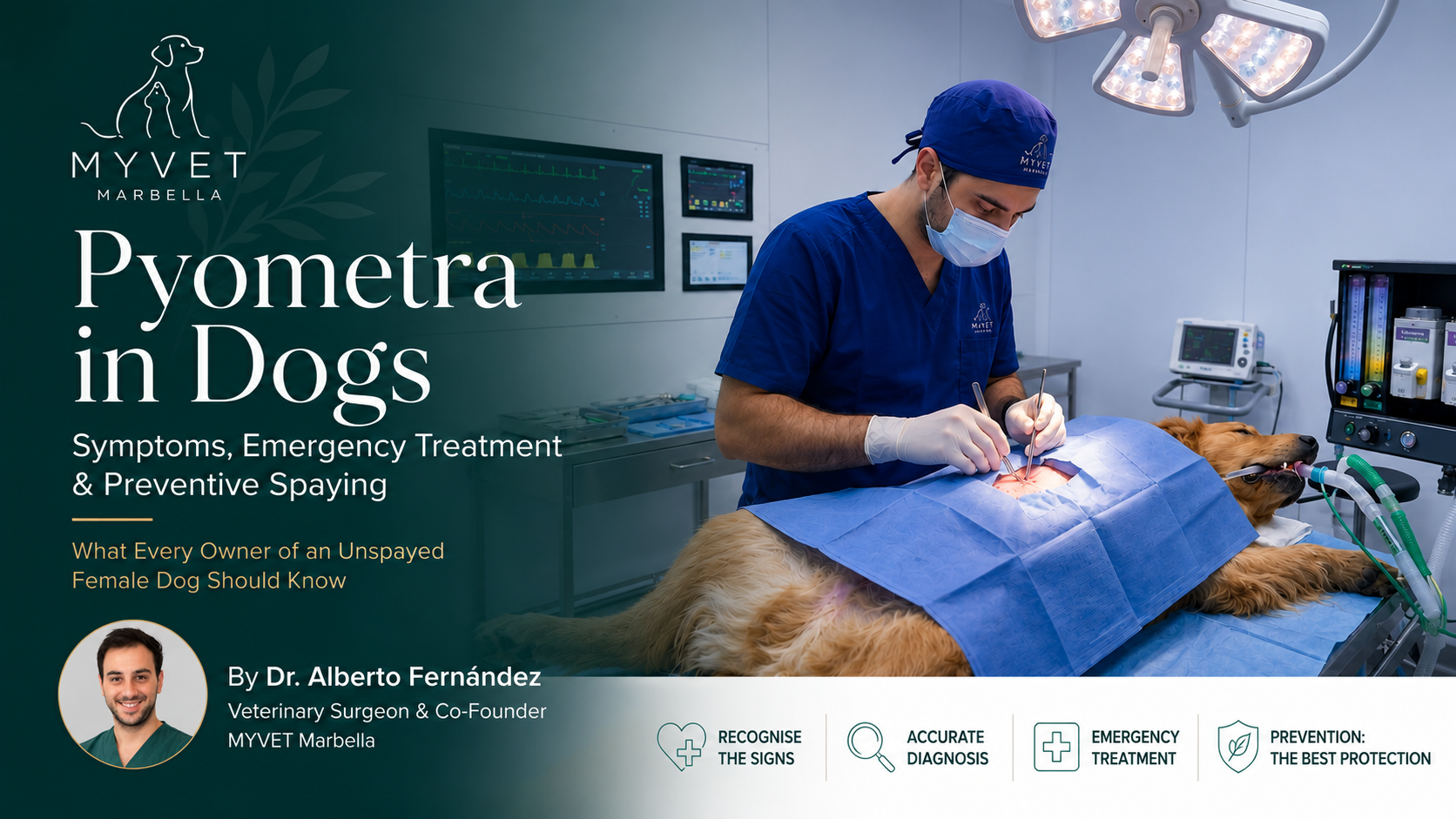
Pyometra is a life-threatening uterine infection in unspayed female dogs. Preventive spaying at the right time can save lives.
Veterinary surgical specialists describe pyometra as a medical emergency that needs rapid intervention to prevent severe infection and death.
In simple words:
Pyometra is not “just an infection”. It is a dangerous internal infection that can make your dog extremely ill and may require emergency surgery.
Why does pyometra happen?
To understand pyometra, we need to understand what happens after a female dog has a heat cycle.
After each season, the body produces hormones — especially progesterone — that prepare the uterus as if pregnancy might happen.
This is normal.
But repeated hormonal cycles can make the uterus more vulnerable over time. The lining of the uterus can change, the natural defences inside the uterus can weaken, and bacteria can grow more easily.
The bacteria most commonly involved is Escherichia coli, often known as E. coli.
Over time, especially in older unspayed female dogs, the risk increases.
Research has shown that pyometra may affect almost 25% of unspayed female dogs before 10 years of age, although risk varies by breed, age and individual factors.
This is why we take pyometra so seriously.
It is common enough that every owner of an unspayed female dog should know about it.
Which dogs are at risk?
Pyometra can affect any unspayed female dog.
It is more common in middle-aged and older dogs, but it can also happen in younger dogs after they have started having heat cycles.
Your dog may be at risk if she:
Has not been spayed
Has had one or more heat cycles
Is middle-aged or older
Has recently finished a season
Has had hormonal treatments
Has had false pregnancies
Has never had puppies
Has had puppies in the past but remains unspayed
A common misunderstanding is that a dog is safe because she has already had puppies.
That is not true.
Having had a litter does not protect a female dog from pyometra.
When does pyometra usually appear?
Pyometra often develops in the weeks after a heat cycle.
This is why, when an unspayed female dog becomes ill after being in season, we always keep pyometra high on our list of possible causes.
If your dog finished her season recently and you notice she is drinking more, eating less, vomiting, tired, uncomfortable or has vaginal discharge, please do not wait.
Call your vet.
The two types of pyometra: open and closed
There are two main forms of pyometra.
Open pyometra
In open pyometra, the cervix is open, which means some of the pus can drain out through the vagina.
Owners may notice discharge that looks:
Creamy
Yellow
Brown
Red
Bloody
Thick
Smelly
Sometimes the dog keeps licking herself, and the discharge is not easy to see.
Open pyometra is very serious, but at least there is some drainage.
Closed pyometra
Closed pyometra is often even more dangerous.
In this case, the cervix is closed, so the pus stays trapped inside the uterus.
The abdomen may become swollen, the infection can worsen rapidly and the risk of rupture or severe sepsis increases.
This is one of the reasons why pyometra can be so frightening: a dog can have a very serious uterine infection even if you do not see any discharge.
No discharge does not mean no problem.
Symptoms of pyometra in dogs
The symptoms can vary from mild to severe.
Some dogs look only slightly unwell at first. Others arrive at the clinic very weak, dehydrated or critically ill.
Watch for:
Drinking much more water than usual
Urinating more than usual
Loss of appetite
Vomiting
Diarrhoea
Lethargy
Weakness
Depression or unusual quietness
Fever
Panting
Swollen abdomen
Pain or discomfort
Vaginal discharge
Excessive licking of the vulva
Pale gums
Collapse
One of the most important warning signs is this combination:
An unspayed female dog + recent heat cycle + drinking more + feeling unwell.
That should always be treated as urgent.
VCA notes that a very ill unspayed female dog drinking increased amounts of water, especially with vaginal discharge or a painful enlarged abdomen, should be suspected of having pyometra.
Why does pyometra make dogs drink so much?
Many owners tell us:
“She is drinking constantly.”
“She is asking to go out to urinate all the time.”
“She has never drunk this much before.”
This happens because the infection and toxins can affect the kidneys and the body’s ability to regulate fluids.
In some cases, pyometra can contribute to acute kidney injury.
That is why blood tests and urine assessment are so important. We are not only confirming the infection. We are also checking how the rest of the body is coping.
Is pyometra painful?
Yes, it can be very painful and uncomfortable.
Dogs are incredibly good at hiding pain. Some will not cry. Some will simply become quiet, stop eating, lie in unusual positions or avoid movement.
A dog with pyometra may look tired rather than obviously painful.
Please do not wait for dramatic signs.
If something feels wrong, especially after a season, it is better to check early.
How is pyometra diagnosed?
At MYVET Marbella, if we suspect pyometra, we need to act quickly and carefully.
Diagnosis usually includes:
1. Clinical examination
We check your dog’s temperature, hydration, gums, abdomen, heart rate, breathing, pain level and general condition.
We also ask about:
Last heat cycle
Appetite
Drinking and urination
Vomiting or diarrhoea
Vaginal discharge
Previous reproductive history
Medication
Any previous hormonal treatment
2. Abdominal ultrasound
Ultrasound is one of the most useful tools for diagnosing pyometra.
It allows us to look at the uterus in real time and assess whether it is enlarged or filled with fluid.
It also helps us differentiate pyometra from other conditions, including pregnancy or other abdominal problems.
3. Blood tests
Blood work is essential.
We want to know:
How severe the infection is
Whether the white blood cells are elevated
Whether there is anaemia
Whether the kidneys are affected
Whether the liver is coping
Whether the dog is safe for anaesthesia
What fluid therapy and stabilisation she may need
4. X-rays
In some cases, radiographs can help us assess the abdomen, especially if the uterus is very enlarged.
However, ultrasound usually gives more specific information about the uterus itself.
Is pyometra an emergency?
Yes.
Pyometra should always be treated as urgent.
This does not mean every dog will die immediately. But it does mean you should not wait several days to “see if she improves”.
The infection can progress rapidly.
The uterus can become fragile.
Toxins can affect the kidneys and bloodstream.
The dog can become septic.
The sooner we diagnose and treat pyometra, the better the chances of a safe recovery.
What is the treatment for pyometra?
In most cases, the recommended treatment is surgery. In most cases, the safest and most effective treatment is emergency surgery to remove the infected uterus and ovaries. You can learn more about our approach to dog surgery at MYVET Marbella and how we plan each procedure with safety, monitoring and recovery in mind.
The surgery is called an ovariohysterectomy, which means removing the ovaries and uterus.
This is similar to a spay, but it is not the same as a routine preventive spay.
When a dog has pyometra, she is already ill. The uterus is infected, enlarged, fragile and filled with pus. The body may be dehydrated, septic or under organ stress.
That makes the surgery more complex and higher risk.
VCA states that for most dogs with pyometra, surgical removal of the uterus and ovaries is the safest and most effective treatment and is strongly recommended.
Why emergency pyometra surgery is more risky than preventive spaying
This is something I wish every owner understood.
A preventive spay is planned.
The dog is healthy.
The blood tests can be checked calmly.
The anaesthetic risk is lower.
The uterus is normal.
The recovery is usually smoother.
The cost is usually lower.
A pyometra surgery is different.
The dog may be weak or dehydrated.
The infection may be advanced.
The uterus may be very enlarged and fragile.
There may be toxin effects on the kidneys.
There may be sepsis.
The anaesthetic risk is higher.
The hospitalisation needs may be greater.
The recovery may be more delicate.
This is why prevention matters so much.
We are not recommending spaying because it is convenient for us.
We recommend it because we have seen what happens when pyometra arrives too late.
Can pyometra be treated with medication instead of surgery?
In selected cases, medical treatment may be considered, usually when the dog is valuable for breeding and the case is stable, open-cervix and carefully monitored.
However, this is not suitable for many dogs and carries risks.
The infection can recur, the dog can deteriorate and emergency surgery may still be needed later.
Specialist veterinary guidance notes that dogs and cats can develop pyometra again after medical treatment and should be spayed once breeding is no longer required.
For most family pets, surgery is usually the safest definitive treatment.
Can pyometra be prevented?
Yes. This is why preventive veterinary care in Marbella is so important: it allows us to plan the right timing for spaying before your dog ever reaches an emergency situation.
The most effective prevention is spaying.
Once the uterus and ovaries are removed, a dog cannot develop a typical uterine pyometra.
This is one of the major health benefits of preventive spaying.
Preventive spaying also eliminates unwanted pregnancies and reduces the risk of some reproductive diseases. Depending on timing, it can also reduce the risk of mammary tumours. AAHA notes that spaying before the first heat minimises mammary cancer risk, while timing decisions should balance breed, size, lifestyle and health factors.
When is the best time to spay a female dog?
There is no single perfect answer for every dog.
The best timing depends on:
Breed
Expected adult size
Age
Heat cycle history
Lifestyle
Behaviour
Orthopaedic risk
Urinary incontinence risk
Mammary tumour risk
Owner circumstances
Whether breeding is intended
At MYVET Marbella, we do not believe in automatic decisions without looking at the individual dog.
However, as a general guide:
Small and toy breed dogs
Many small dogs can be spayed around 5–6 months of age, often before the first heat, depending on their health and development.
Medium-sized dogs
For many medium-sized dogs, the decision may be around 6–12 months of age, sometimes after the first heat, depending on the individual dog and clinical assessment.
Large and giant breed dogs
For large and giant breeds, we often discuss waiting longer to allow musculoskeletal development, especially in breeds with higher orthopaedic risks.
This may mean waiting until growth is more complete.
The key message is not “early is always best” or “late is always best”.
The key message is:
Plan it with your vet before there is an emergency.
What if my dog is already older and unspayed?
It is not too late to talk about prevention.
Many owners of older female dogs tell us:
“She has never had a problem before.”
“She is too old for surgery.”
“She has always been fine after her seasons.”
“I thought pyometra only happened to other dogs.”
But pyometra is often a disease of adult and older unspayed female dogs.
If your dog is older and has not been spayed, we can assess her general health, run blood tests, discuss anaesthetic risk and help you decide whether preventive surgery is appropriate.
In some cases, preventive surgery may still be safer than waiting for a life-threatening emergency.
What should you do if you suspect pyometra?
If your unspayed female dog is unwell, especially after a heat cycle, contact your vet immediately.
Do not wait.
Do not give leftover antibiotics.
Do not assume it is a stomach upset.
Do not wait for visible discharge.
Do not wait until she collapses.
Call your vet and explain:
She is not spayed
When her last heat was
Whether there is discharge
Whether she is drinking more
Whether she is eating
Whether she is vomiting
Whether she seems weak or painful
This information helps us decide how urgent the situation is.
If your unspayed female dog has recently been in heat and is now drinking more, vomiting, tired, not eating or showing vaginal discharge, please Contact MYVET Marbella as soon as possible.
A personal message from Alberto
As vets, we develop a special relationship with prevention.
Because we know the emergencies that could have been avoided.
Every time I operate on a dog with pyometra, I feel two things at the same time.
First, the pressure and responsibility of helping that dog survive.
Second, the sadness of knowing that this disease often did not need to happen.
Rocío and I understand that deciding to spay your dog can feel emotional. For some families, it is a difficult decision. Some owners worry about anaesthesia. Others wonder whether they should allow one heat cycle. Others have heard different opinions from friends, breeders or online forums.
That is completely understandable.
But what I would ask is this:
Please do not make the decision based on fear, myths or guesswork.
Make it with proper veterinary guidance.
Ask questions.
Understand the risks.
Understand the benefits.
Consider your dog’s breed, size and lifestyle.
Plan ahead.
Because preventive surgery performed at the right time, in a healthy dog, is very different from emergency surgery in a critically ill dog.
And if we can prevent suffering, we should.
How MYVET Marbella can help
At MYVET Marbella, we can help you make the best decision for your female dog.
We offer:
Preventive health consultations
Spay timing advice
Pre-anaesthetic blood tests
Ultrasound assessment when needed
Safe surgical planning
Pyometra emergency assessment
Post-operative care
Clear guidance in English and Spanish
If your female dog is not spayed, or if she has recently been in heat and seems unwell, please contact MYVET Marbella.
We serve families in Marbella, San Pedro de Alcántara, Nueva Andalucía, Estepona, Benahavís and across the Costa del Sol.
Pyometra is real.
It is serious.
But in many cases, it is preventable.
And your dog deserves the chance to be protected before an emergency happens.
Frequently Asked Questions About Pyometra in Dogs
What is pyometra in dogs?
Pyometra is a serious infection of the uterus that affects unspayed female dogs. The uterus fills with pus and bacteria, and the infection can become life-threatening.
Is pyometra an emergency?
Yes. Pyometra should always be treated as urgent because it can progress quickly and cause sepsis, kidney damage, uterine rupture or death.
What are the first signs of pyometra?
Common early signs include drinking more water, urinating more, tiredness, reduced appetite, vomiting, vaginal discharge or seeming generally unwell after a heat cycle.
Can a dog have pyometra without discharge?
Yes. In closed pyometra, the cervix is closed and pus remains trapped inside the uterus. This can be even more dangerous because owners may not see any discharge.
How is pyometra diagnosed?
Diagnosis usually involves a clinical examination, abdominal ultrasound, blood tests and sometimes X-rays.
What is the best treatment for pyometra?
For most dogs, the safest and most effective treatment is emergency surgery to remove the infected uterus and ovaries.
Can antibiotics cure pyometra?
Antibiotics alone are usually not enough. Medical treatment may be considered only in selected breeding cases, but relapse is possible and surgery is often still needed.
Can pyometra be prevented?
Yes. Spaying removes the uterus and ovaries and prevents typical uterine pyometra.
When should I spay my dog?
The best timing depends on breed, size, age, health and lifestyle. Small dogs may be spayed earlier, while large breeds may benefit from waiting longer. Your vet can help decide the safest timing.
Should I spay my older dog?
If your older female dog is unspayed, speak to your vet. In some cases, preventive surgery may still be safer than waiting for a possible pyometra emergency.
If your female dog is not spayed, or if she has recently been in heat and seems unwell, do not wait. Book a consultation with MYVET Marbella and let us help you protect her health before it becomes an emergency.
If you live with a dog on the Costa del Sol, you may also find these guides useful:
Preventive veterinary care in Marbella
Dog surgery at MYVET Marbella
