Heatstroke in Dogs and Cats in Marbella: What Every Pet Owner Must Know This Summer

By Dr. Rocío Cromstedt Lavigne, MRCVS
Veterinary Surgeon & Co-Founder of MYVET Marbella
With Dr. Alberto Fernández, Veterinary Surgeon & Co-Founder of MYVET Marbella
Every summer in Marbella, Alberto and I see the same fear in pet owners’ faces.
“My dog was fine this morning.”
“My cat was only on the terrace for a while.”
“We only went for a short walk.”
“He was just in the car for a few minutes.”
And suddenly, their pet is panting heavily, weak, confused, vomiting or unable to stand.
Heatstroke is one of the most frightening emergencies we can face as veterinarians because it can happen fast, it can become life-threatening in minutes, and many owners do not realise how serious it is until their pet is already in danger.
Here in Marbella, San Pedro de Alcántara, Guadalmina, Nueva Andalucía and Puerto Banús, summer is beautiful. We live outdoors. We walk by the beach, have lunch on terraces, spend time in gardens and enjoy long sunny days.
But for dogs and cats, the same summer lifestyle can become dangerous.
Our pets do not cool down like we do. Dogs mainly rely on panting. Cats are often more discreet, but they can also overheat, especially in poorly ventilated rooms, terraces, cars, carriers or sunny apartments.
This article is written with one goal: to help you recognise heatstroke early, act correctly and prevent a tragedy before it happens.
Because when it comes to heatstroke, the first minutes matter.
What is heatstroke?
Heatstroke happens when your pet’s body temperature rises dangerously and the body can no longer cool itself properly.
This is not simply “being hot”.
Heatstroke is a medical emergency.
When body temperature rises too much, it can damage the brain, kidneys, liver, heart, gut, blood clotting system and other organs. If treatment is delayed, heatstroke can lead to shock, seizures, organ failure and death.
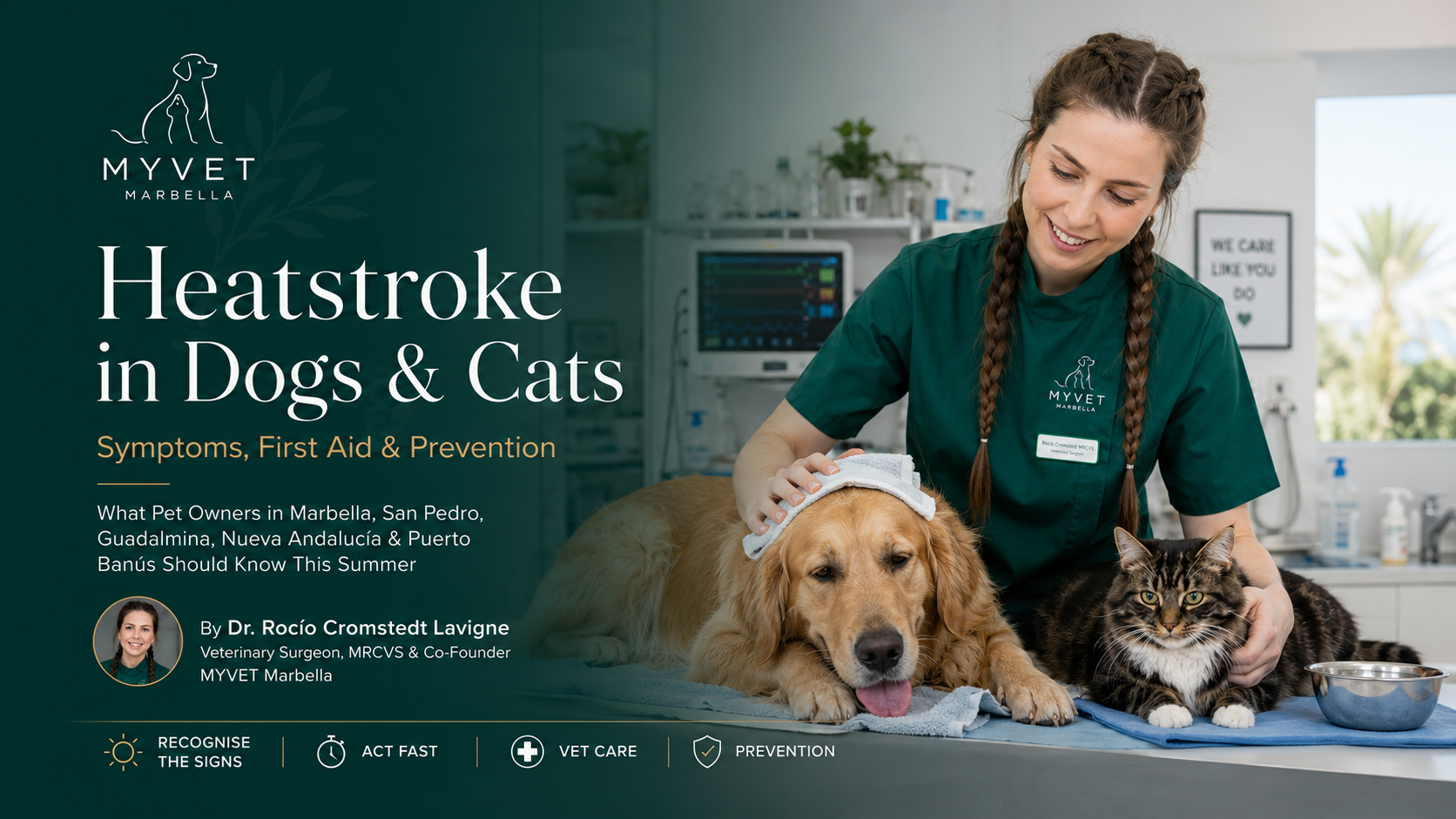
Heatstroke can become life-threatening for dogs and cats in Marbella’s summer heat. Early action and prevention can save lives.
The scary part is that it does not always require an extreme situation.
A walk at the wrong time of day, a few minutes in a hot car, intense play in the garden, a sunny terrace, poor ventilation or a pet with breathing problems can be enough.
Why is heatstroke such a risk in Marbella?
In Marbella and the Costa del Sol, summer heat is not just about temperature.
It is also about sun exposure, humidity, hot pavements, terraces, parked cars, beach walks, outdoor restaurants, villas with gardens and apartments that heat up during the day.
Areas like San Pedro de Alcántara, Guadalmina, Nueva Andalucía and Puerto Banús are full of places where families naturally want to take their pets.
That is understandable.
But in July, August and hot September days, even a short walk or a few minutes of direct sun can be too much for some animals.
The risk is especially high during the middle of the day and late afternoon, when pavements and walls have absorbed heat for hours.
If the ground feels hot to your hand, it is too hot for your dog’s paws.
Dogs most at risk of heatstroke
Any dog can suffer heatstroke, but some are much more vulnerable.
Higher-risk dogs include:
French Bulldogs
English Bulldogs
Pugs
Boston Terriers
Boxers
Shih Tzus
Cavalier King Charles Spaniels
Senior dogs
Puppies
Overweight dogs
Dogs with heart disease
Dogs with respiratory disease
Dogs with laryngeal paralysis
Dogs with thick coats
Dogs that are not used to heat
Dogs that exercise intensely
Dogs with previous heatstroke history
Short-nosed breeds are especially vulnerable because they already struggle to move air efficiently. For them, summer in Marbella can be dangerous even when the walk seems short.
Can cats get heatstroke?
Yes.
Cats are generally better than dogs at avoiding heat because they tend to rest, hide and reduce activity. But they can absolutely suffer heatstroke.
Cats may be at risk if they are:
Left in a hot room
Trapped on a terrace or balcony
Transported in a carrier without ventilation
Left inside a car
Very old or very young
Overweight
Long-haired
A flat-faced breed, such as Persian or Exotic Shorthair
Suffering from heart or respiratory disease
Unable to access shade or water
Cats often show heat stress more quietly than dogs. This makes it easier to miss the early warning signs.
Symptoms of heatstroke in dogs and cats
Please take these signs seriously.
Early signs may include:
Heavy panting
Restlessness
Excessive drooling
Bright red or dark gums
Fast breathing
Fast heart rate
Weakness
Seeking shade or lying down suddenly
Refusing to continue walking
Anxiety or distress
More serious signs include:
Vomiting
Diarrhoea
Bloody diarrhoea
Confusion
Staggering or wobbling
Collapse
Pale, blue or grey gums
Seizures
Unconsciousness
Extreme lethargy
Difficulty breathing
In cats, signs may include:
Open-mouth breathing
Panting
Drooling
Hiding
Weakness
Collapse
Vomiting
Red or pale gums
Distress
Not responding normally
A very important point: do not wait until your pet collapses.
If your dog or cat is overheating and behaving abnormally, act immediately.
What to do immediately if you suspect heatstroke
If you think your pet has heatstroke, do not wait to “see if they improve”.
Start first aid and contact a vet immediately.
1. Move your pet away from heat
Take your pet into shade, an air-conditioned room or a cool indoor area.
Remove them from the car, terrace, beach, garden or pavement immediately.
2. Start cooling your pet
Use cool water, not ice-cold water.
Wet the body, especially:
Neck
Chest
Belly
Armpits
Groin
Paws
Use a fan or air conditioning if available.
Cooling works best when water and air movement are combined.
3. Offer water, but do not force it
If your pet is conscious and able to swallow normally, offer small amounts of cool water.
Do not force water into the mouth.
Do not allow them to drink huge amounts too quickly if they are vomiting, weak or confused.
4. Call your vet immediately
Even if your pet seems to improve after cooling, heatstroke can cause internal damage that is not visible at first.
Your pet may still need blood tests, oxygen, intravenous fluids, temperature monitoring and hospitalisation.
5. Transport safely
Once cooling has started, transport your pet to the veterinary clinic.
Keep the car cool with air conditioning.
Do not wrap your pet tightly in wet towels, as this can trap heat. If you use wet towels briefly, replace them frequently and combine with airflow.
What not to do
Please avoid these common mistakes:
Do not use ice baths.
Do not delay calling the vet.
Do not force your pet to drink.
Do not give human medication.
Do not wait until symptoms become severe.
Do not assume your pet is fine because they stopped panting.
Do not leave them in a hot car while you call for help.
Do not cover them tightly with towels.
Heatstroke is not a “home treatment” condition.
First aid can save time, but veterinary care is still essential.
What will the vet do?
At MYVET Marbella, when a pet arrives with suspected heatstroke, our priority is to stabilise them quickly and safely.
Depending on the severity, treatment may include:
Controlled cooling
Oxygen therapy
Intravenous fluids
Blood tests
Electrolyte monitoring
Blood glucose assessment
Kidney and liver evaluation
Coagulation checks
Anti-nausea medication
Seizure control if needed
Pain relief if appropriate
Monitoring for shock
Hospitalisation
Repeat blood tests over the following hours or days
Heatstroke can continue to affect the body after the temperature starts to come down.
That is why monitoring is so important.
Why heatstroke can be dangerous even after your pet seems better
This is one of the most important things I want owners to understand.
A dog or cat may look better after cooling.
They may stop panting.
They may stand up.
They may seem more alert.
But internal damage may already have started.
Heatstroke can affect the kidneys, gut, brain, blood clotting system and circulation. Some complications develop later.
That is why veterinary assessment is essential even if your pet appears to recover at home.
Prevention: the best treatment is avoiding heatstroke completely
The best way to treat heatstroke is to prevent it.
In Marbella, prevention must be part of your summer routine.
Walk at safe times
In summer, avoid walking dogs during the hottest hours.
Choose early morning or late evening.
For many dogs in Marbella, San Pedro, Guadalmina, Nueva Andalucía and Puerto Banús, this means avoiding walks from late morning until evening on very hot days.
Some days are simply too hot for a walk.
Mental stimulation indoors is safer than a dangerous walk outside.
Check the pavement
Place the back of your hand on the pavement for a few seconds.
If it feels too hot for your hand, it is too hot for your dog’s paws.
Hot pavements can burn pads and increase body temperature quickly.
Never leave pets in cars
Never leave your dog or cat inside a parked car in summer.
Not for five minutes.
Not with the windows slightly open.
Not in the shade.
Cars heat up extremely fast, and pets can die in a very short time.
Be careful with terraces and balconies
Terraces in Marbella can become dangerously hot.
Tiles, artificial grass and enclosed outdoor spaces can trap heat.
Always make sure your pet has shade, ventilation and water.
Avoid intense exercise
Running, ball chasing, cycling with dogs and beach play can be dangerous during summer heat.
Dogs often continue playing because they want to please us.
It is our responsibility to stop before it becomes unsafe.
Provide fresh water everywhere
Have water available in multiple places:
Home
Garden
Terrace
Car
Walks
Travel carrier
For cats, consider several water bowls or a fountain.
Use air conditioning and ventilation
Indoor pets can also overheat.
This is especially important for cats, senior pets and brachycephalic breeds.
Do not leave pets in closed rooms without ventilation during hot days.
Grooming helps, but shaving is not always the answer
Regular grooming can help remove dead coat and improve comfort.
However, shaving some breeds too short can reduce natural coat protection.
Ask your vet or groomer before making major coat changes.
Special advice for dogs in Puerto Banús, beach areas and outdoor restaurants
Many families love taking their dogs to beachside areas, marinas and terraces.
But remember:
Shade moves during the day.
Pavement and decking can become extremely hot.
Dogs under restaurant tables may still be overheating.
Excitement and social stimulation increase body temperature.
Sea water is not drinking water.
A wet dog can still overheat in the sun.
Sand can also become very hot.
If you take your dog out, bring water, choose shade, keep the visit short and watch their breathing constantly.
A personal message from Rocío
As veterinarians, Alberto and I love seeing pets enjoy life with their families.
We love seeing dogs on morning walks, cats relaxing in sunny windows and families sharing their lives with animals they truly adore.
But summer makes me feel protective.
Because I know how quickly joy can turn into panic when a pet overheats.
Heatstroke is not about bad owners. Many cases happen to loving families who simply did not realise how fast it could happen.
That is why education matters.
If this article makes one family skip a midday walk, move their cat out of a hot room, avoid leaving a dog in the car, or call a vet earlier, then it can save a life.
Our pets trust us completely.
They cannot tell us, “I am too hot.”
They cannot check the pavement.
They cannot decide the safest walking time.
They cannot open the car door.
That responsibility belongs to us.
And in Marbella’s summer, that responsibility matters every single day.
How MYVET Marbella can help
At MYVET Marbella, we are here to help families protect their dogs and cats throughout the summer.
We can help with:
Heatstroke emergency assessment
Summer safety advice
Senior pet health checks
Brachycephalic breed advice
Heart and respiratory evaluations
Weight management
Preventive veterinary care
Travel and carrier safety advice
Clear guidance in English and Spanish
If your dog or cat shows signs of heatstroke, please contact a veterinary clinic immediately.
If you are in Marbella, San Pedro de Alcántara, Guadalmina, Nueva Andalucía, Puerto Banús or nearby, contact MYVET Marbella and we will guide you on the safest next step.
Heatstroke is fast.
But fast action can save lives.
Frequently Asked Questions About Heatstroke in Dogs and Cats
Is heatstroke an emergency in pets?
Yes. Heatstroke is a veterinary emergency. It can cause organ damage, shock, seizures and death if treatment is delayed.
What are the first signs of heatstroke in dogs?
Early signs include heavy panting, excessive drooling, restlessness, fast breathing, weakness, red gums and refusing to continue walking.
Can cats get heatstroke?
Yes. Cats can suffer heatstroke, especially if they are trapped in a hot room, car, terrace, carrier or poorly ventilated space.
What should I do first if my pet has heatstroke?
Move your pet to shade or air conditioning, start cooling with cool water and airflow, offer small amounts of water if conscious, and contact a vet immediately.
Should I use ice water?
No. Use cool water, not ice-cold water. Very cold water or ice baths can cause problems and may slow effective cooling.
Should I take my pet to the vet even if they improve?
Yes. Internal damage can continue after your pet seems better. Veterinary assessment is strongly recommended after suspected heatstroke.
Are flat-faced dogs more at risk?
Yes. Brachycephalic breeds such as Bulldogs, Pugs and French Bulldogs are at higher risk because they have more difficulty cooling themselves through breathing.
Can dogs get heatstroke during a short walk?
Yes. In hot weather, even a short walk can be dangerous, especially on hot pavement, in direct sun or during the middle of the day.
How can I prevent heatstroke in Marbella?
Walk early morning or late evening, avoid hot pavements, never leave pets in cars, provide shade and water, avoid intense exercise and use air conditioning or ventilation indoors.
What areas does MYVET Marbella serve?
MYVET Marbella helps pet owners in Marbella, San Pedro de Alcántara, Guadalmina, Nueva Andalucía, Puerto Banús, Benahavís, Estepona and across the Costa del Sol.
Author: Dr. Rocío Cromstedt Lavigne
Veterinary Surgeon, MRCVS & Co-Founder of MYVET Marbella
If your dog or cat is panting heavily, weak, vomiting, confused, collapsing or showing signs of overheating, do not wait. Move them to a cool place, start safe cooling and contact MYVET Marbella immediately.
Related articles
If you live with a dog or cat on the Costa del Sol, you may also find these guides useful: